I tried to outsource the most human thing about me.
AI couldn't write in my voice, so I explored tone through movement and discovered something unexpected: your voice doesn't exist until someone listens.
I tried to outsource the most human thing about me.
April 7, 2026 I hadn’t been on LinkedIn in a long time. Like most people, I am pressed for time. So when I decided to start showing up again, I did what felt logical: I tried to use AI to write in my voice. I followed the principles - feed it samples, adjust the prompts, give it strong examples. Awesome, I thought. I’ll save myself hours.
But.. it didn’t sound like 𝘮𝘦.
The more I adjusted, the worse the output. Fluent, coherent, entirely unconvincing. Short sentences. Punchy lines. Skimmable. Emojis. It sounded like every other AI slop article on LinkedIn that stirs something uncomfortable in my belly. And somewhere in that frustration I caught myself thinking: 𝘸𝘩𝘢𝘵 𝘥𝘪𝘥 𝘐 𝘢𝘤𝘵𝘶𝘢𝘭𝘭𝘺 𝘦𝘹𝘱𝘦𝘤𝘵? It’s not me. It has no character, no body, no history, no gut feelings, no relationship with my world. I was asking a machine to speak for me, and then surprised when it couldn’t.
But that raised a more interesting question. If AI can’t locate something this fundamentally human, how do I? What does my tone of voice actually feel like? And if I know the answer is somewhere in my body, how do I get to it?
The question wasn’t going to be answered by ChatGPT or a Google search. I had to let it sit.
A few days earlier I’d been on the lawn in Victoria Park with Dean Philp , a movement facilitator and friend, eating banh mi under the eucalypts while everyone else was at their desks. He was planning a movement retreat and asked if I’d run a session. Pick a topic, he said. Something worth exploring.
Now I had one.
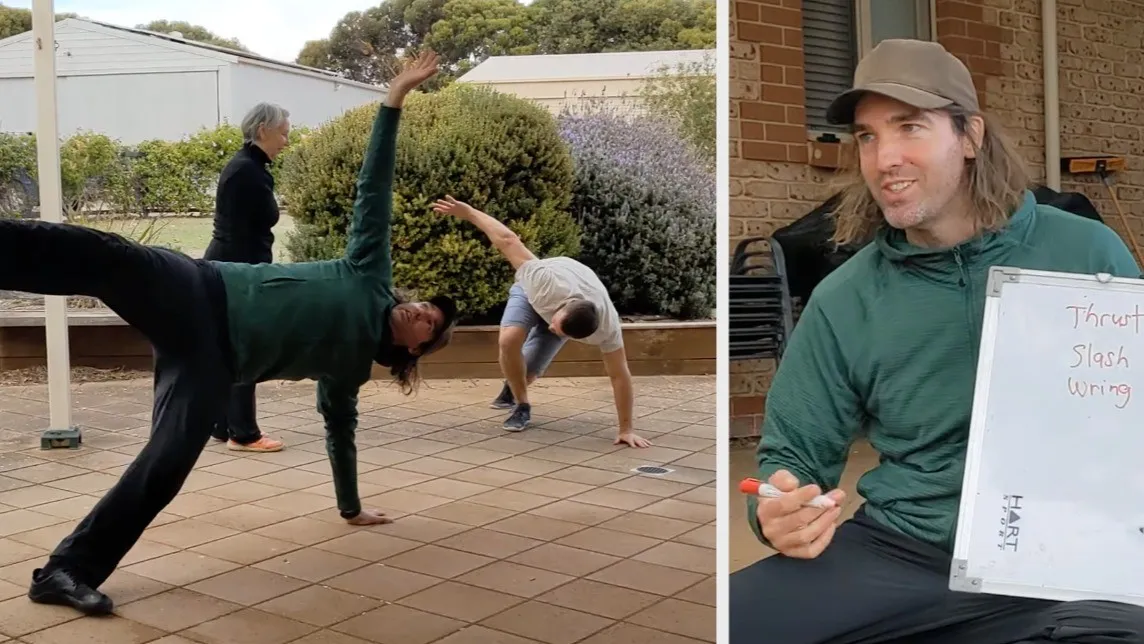
What followed was a week of quiet germination. Not locked in a room trying to think my way to an answer, but carrying the question loosely. Monday it arrived. Tuesday it had a shape. Wednesday, over dinner with my partner Mim - who trained as an actor - she mentioned Laban Movement Analysis, a framework for understanding how the body speaks through distinct qualities of effort and movement. Something in that landed. Thursday the shakers appeared in my thinking. Thursday night I had a session structure. Saturday I facilitated it.
The question I brought into the room: what is my tone of voice? I want to explore it with my body, without using my voice.
We gathered in a circle. I started by asking the group two things: what comes to mind when I say “tone”? And what comes to mind when I say “voice”?
The group had a collective intelligence I could tap into - a Socratic starting point, surfacing shared assumptions before we moved anything. Tone brought up timbre, colour, weight, energy, emotion, rhythm. Voice brought up identity, character, opinion, connection. The distinction that emerged felt important. Tone is subtext and voice is content.
Then we moved.
Music on. I walked them through eight effort qualities: thrust, dab, float, press, wring, glide, slash and flick. I asked them to find each one in their body, one quality at a time. Some came easily while others felt foreign. Nobody moved the same way. It’s always good to establish a baseline, to let people arrive in their bodies before we shift our attention.
Then I introduced shakers.
Egg shakers, containers I’d made from household objects, different sizes and weight in the hand. Same instruction: move through the eight qualities, but now you have audio feedback. You can hear yourself.
Something shifted. Movement that had been internal became audible. A thrust with a shaker sounds different from a thrust without one. Now, you could hear the difference between a slash and a flick in a way you couldn’t quite feel - an immediate auditory feedback loop.
Then we paired off, eyes closed. Call and response - one person makes a sound, the other matches it.
People discovered they could hear better in one ear than the other. The exercise became spatial, moving the shaker through three-dimensional space. And there was a constraint nobody had anticipated: you could only really make a sound if you were moving. Stillness was silence. To have a voice, you had to keep moving.
We changed pairs, changed tools, ensuring that we spoke with different bodies, different minds. One person with two shakers moving through the group, everyone standing still, responding to what they heard. Then three people with shakers at once - chaotic, less like a conversation, more like an ambush. Agency dissolved entirely. (If you want to explore the idea of agency in movement further, Dean Philp ‘s work is worth your time.)
We finished with everyone moving freely through all eight qualities, choosing what they wanted to explore. No instruction. Just listening.
And somewhere in the middle of that, the session stopped being about voice.
I came looking for something about myself, a personal quality I could locate and name. What I found instead was that tone of voice doesn’t exist in isolation. It only becomes voice when someone receives it. Without a listener, it’s just signal. Noise in a room.
Tone of voice is relational, not individual.
That’s not what I was looking for when I opened the AI tool. It’s not what I expected to find on a movement retreat.
Don’t get stuck at the desk looking for answers. 𝗧𝗵𝗲 𝗮𝗻𝘀𝘄𝗲𝗿𝘀 𝗮𝗿𝗲 𝗶𝗻𝘀𝗶𝗱𝗲 𝘂𝘀 - 𝘄𝗲 𝗷𝘂𝘀𝘁 𝗻𝗲𝗲𝗱 𝘁𝗼 𝘀𝗵𝗮𝗸𝗲 𝘁𝗵𝗲𝗺 𝗼𝘂𝘁 𝘀𝗼𝗺𝗲𝘁𝗶𝗺𝗲𝘀.
I work at the intersection of technology, strategy, and embodied practice. If this kind of thinking is useful to you, follow along.