Omada Bar & Grill
Greek-inspired restaurant launching with no visual identity. Built complete brand system from concept through comprehensive guidelines and multi-touchpoint execution.
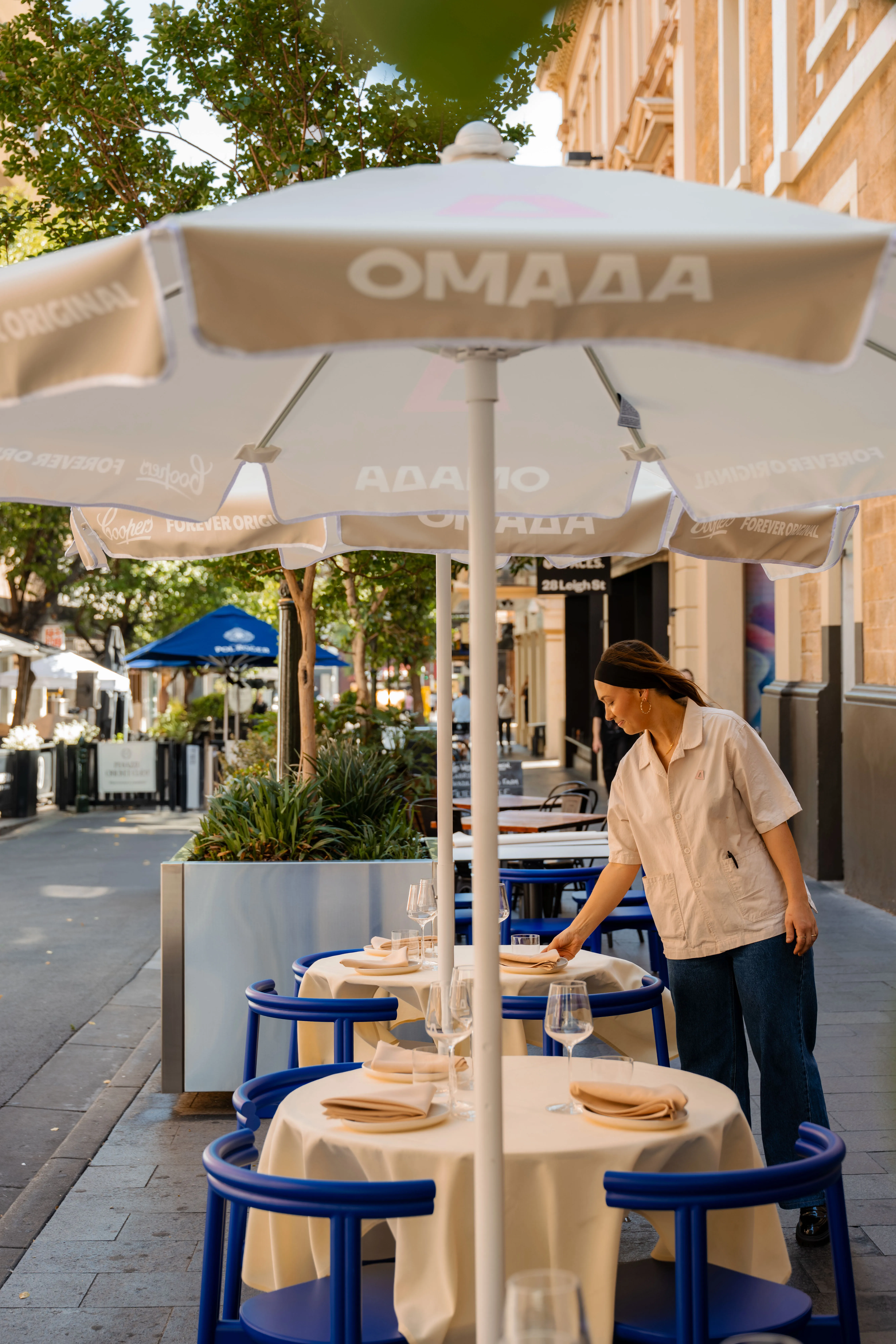
Omada Bar & Grill
At a Glance
- Client: Omada Bar & Grill (Emma and Simon Kardachi / Food and Wine Collective)
- Project: Full brand identity, guidelines, digital presence, and multi-touchpoint execution
- Timeline: Aug 2025 to Feb 2026 (staged rollout)
- Scope: Brand strategy, logo system, colour and typography, website (staged rollout), print collateral, spatial branding, brand guidelines
- Key result: Launched to critical coverage in Gourmet Traveller; brand system held across every touchpoint from frosted glassware to hand-painted venue walls
Problem
Omada Bar & Grill was launching as a premium dining venue in Adelaide with a clear concept: a Greek-inspired restaurant focused on fire-cooked food, hospitality, and connection. But there was no visual identity to express it. The Food and Wine Collective (Emma and Simon Kardachi) engaged me to build the complete brand from scratch: logo, colour system, typographic guidelines, and a cohesive visual language that would work across every customer touchpoint.
The challenge wasn’t simply aesthetic. It required strategic research, conceptual clarity, and the ability to navigate client expectations while executing across multiple mediums simultaneously.
The market context made the stakes clear. Before touching any design work, I conducted market research to understand Adelaide’s dining landscape and who Omada was actually for. That research identified the target audience as the city’s 30-45-year-old professional demographic: experienced, design-conscious diners who discover venues via Instagram and peer recommendations. Starting with the market was a deliberate choice. Good brand work requires holding several things in tension: the client’s vision, the audience’s expectations, a sense of what’s current, and a feel for what will last. My own instincts matter, but they’re one input, not the brief.
That research also clarified the competitive stakes. The Food and Wine Collective already operates Osteria Oggi, Fugazzi, and Shōbōsho: three of Adelaide’s most respected and design-led venues. Omada needed to open at that standard, not work toward it over time. The target audience already knows these venues. They notice inconsistent branding. A weaker identity at launch would have sat oddly next to the rest of the portfolio.
The research established one more clear constraint: the audience actively rejects Mediterranean clichés. Specifically, the brief ruled out anything resembling a gyros cafe, blue and white chequers, colonial imagery, theme-park aesthetics. The brand needed to express Greek heritage through a contemporary, restrained lens.
Scope and constraints:
- No existing identity, assets, or visual direction to build from
- Staged launch with hard dates: soft opening Dec 08, 2025; full site by Feb 2026
- Many stakeholders with distinct views: owners, partners, head chef, head of bar, front of house. Emma ran point for all creative decisions. Having a single empowered contact on the client side is what makes a project like this move cleanly. It keeps feedback consolidated and lets the work progress without getting caught in competing approvals.
The strategic tensions:
- Monolithic vs. dynamic. The client wanted a brand inspired by ancient Greek architecture, forms with permanence and weight. But the requested Delta symbol (Δ) is geometric by nature. These two instincts needed conceptual resolution, not compromise.
- Sophistication vs. warmth. The target demographic wants elegance and approachability simultaneously. Too much refinement reads cold. Too much warmth reads cheap. The brand needed to hold both.
- Options, not iterations. Presenting three directions strong enough that the client could have run with any of them is a different outcome than presenting one and hoping for approval. It gave the team real choices, brought stakeholders into the decision rather than around it, and kept the project moving without the drag of rounds of revision.
Approach
1. Research and Field Work
The market research established what the audience expected and what the competitive landscape looked like. But I went further: while the brand direction was still being developed, I happened to be in Greece. Rather than working from reference boards, I did photographic research on the ground, walking through Athens’ urban architecture, documenting street art, studying the colour relationships in the city itself. Embodying the culture firsthand changed what felt authoritative versus decorative, and that shifted the whole system.
2. Resolving the Monolithic vs. Delta Tension
The client’s brief called for the Delta symbol (Δ), but the client was initially unconvinced it could carry the permanence the brand required. The job was to convince them, not to override the brief.
The conceptual answer was twofold: the Delta mark itself was designed as a blocky, solid form, not the lightweight geometric outline you might expect. And when applied at scale, etched into glass bottles, frosted onto wine glasses, hand-painted onto venue walls, the symbol inherited the physical weight of its environment. Monolithic through form and through application.
Convincing the client the Delta could work with the right treatment, rather than substituting a different mark, preserved the original brief while solving the problem they had identified. The Delta held.
Dionysus provided the counterweight: hospitality, warmth, expressiveness, a reason to celebrate. These two ideas held the tension the brief required without collapsing into either extreme.
3. Identity Development
The wordmark and Delta icon system were built for clarity at scale and flexibility across disparate contexts: signage, frosted glassware, kraft paper tags, menus, digital.
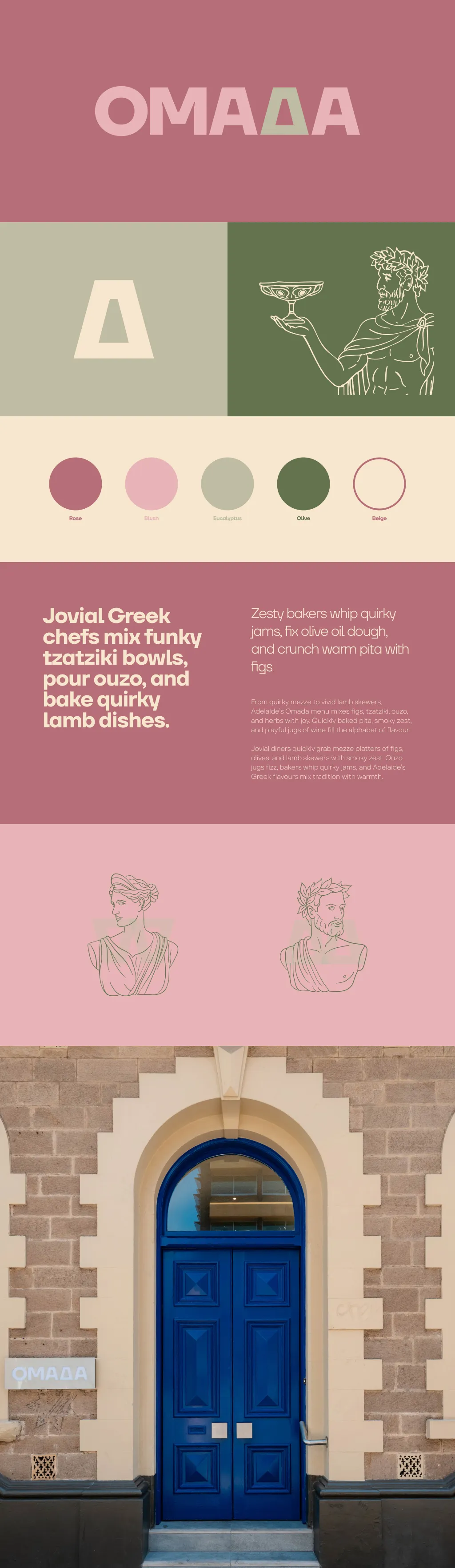
Two versions of the Dionysus illustration were developed: a raw, hand-drawn charcoal sketch for brand storytelling and tactile collateral, and a cleaned-up version for high-visibility signage where legibility at distance mattered. When the business development officer reviewed it and specifically requested the rawer version, feeling the Greek and rustic quality suited the brand better, it confirmed the right direction: the authenticity marker needed to feel made, not produced.
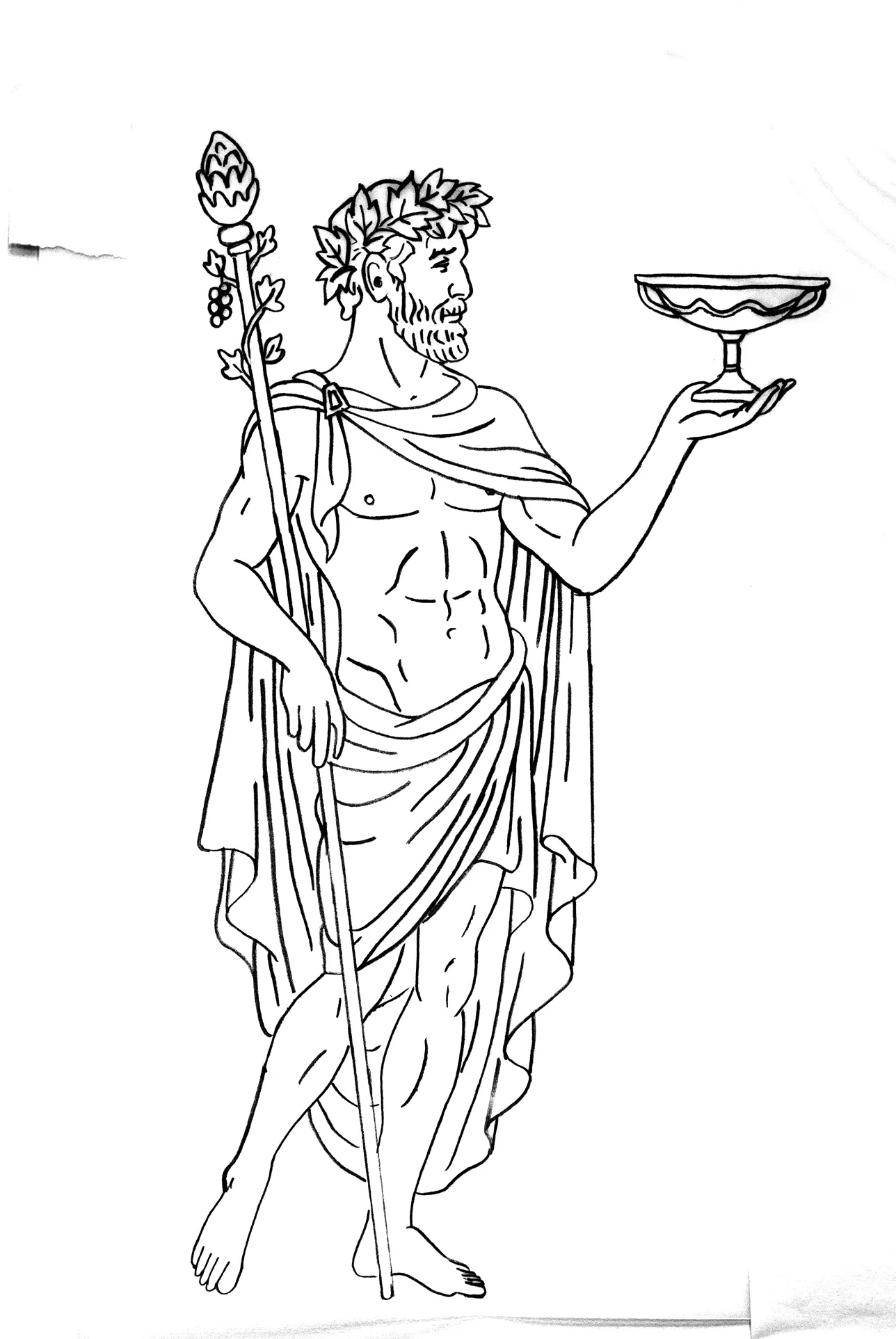
Typography: TT Firs Neue (Black, Bold, Medium) and TT Firs Text (Light), a dual-weight system that kept the identity legible and modern without leaning into ornamental Greek-revival clichés.
4. Colour System
The palette came directly from what I observed in Athens: the rose and blush tones of the city’s painted building facades set against the olive and eucalyptus greens of street trees lining the footpaths. A colour system grounded in place, not trend.
The Sacred: Olive Green and Eucalyptus reference Athena’s gift of the olive, timeless, divine, permanent. These anchored the palette in the architectural weight the client wanted.
The Streets: Rose and Blush reflect the lived-in warmth of everyday Athenian facades, moving the brand away from cold sterility toward the approachability the target market expects.
A warm beige underpins the system: whitespace on menus, background on collateral, breathing room throughout. The palette was tested across every medium before being codified in guidelines.
5. Multi-Touchpoint Execution
Digital presence: The site launched in stages aligned with the venue’s opening timeline. A restrained holding page held the space ahead of the soft opening: email capture, no imagery, no menus. The soft opening site was video-only, no static images, no animations, an elusive digital experience built to create anticipation rather than reveal everything. The full site expanded once the venue was open and had the content to match it.
One specific constraint shaped all of this: the restaurant wasn’t open yet. There were no real assets to work with. No photography, no atmosphere, no food to document. Building genuine anticipation and brand credibility through design alone, without the crutch of imagery, required different judgment than a conventional site build.
Printed collateral and table experience:
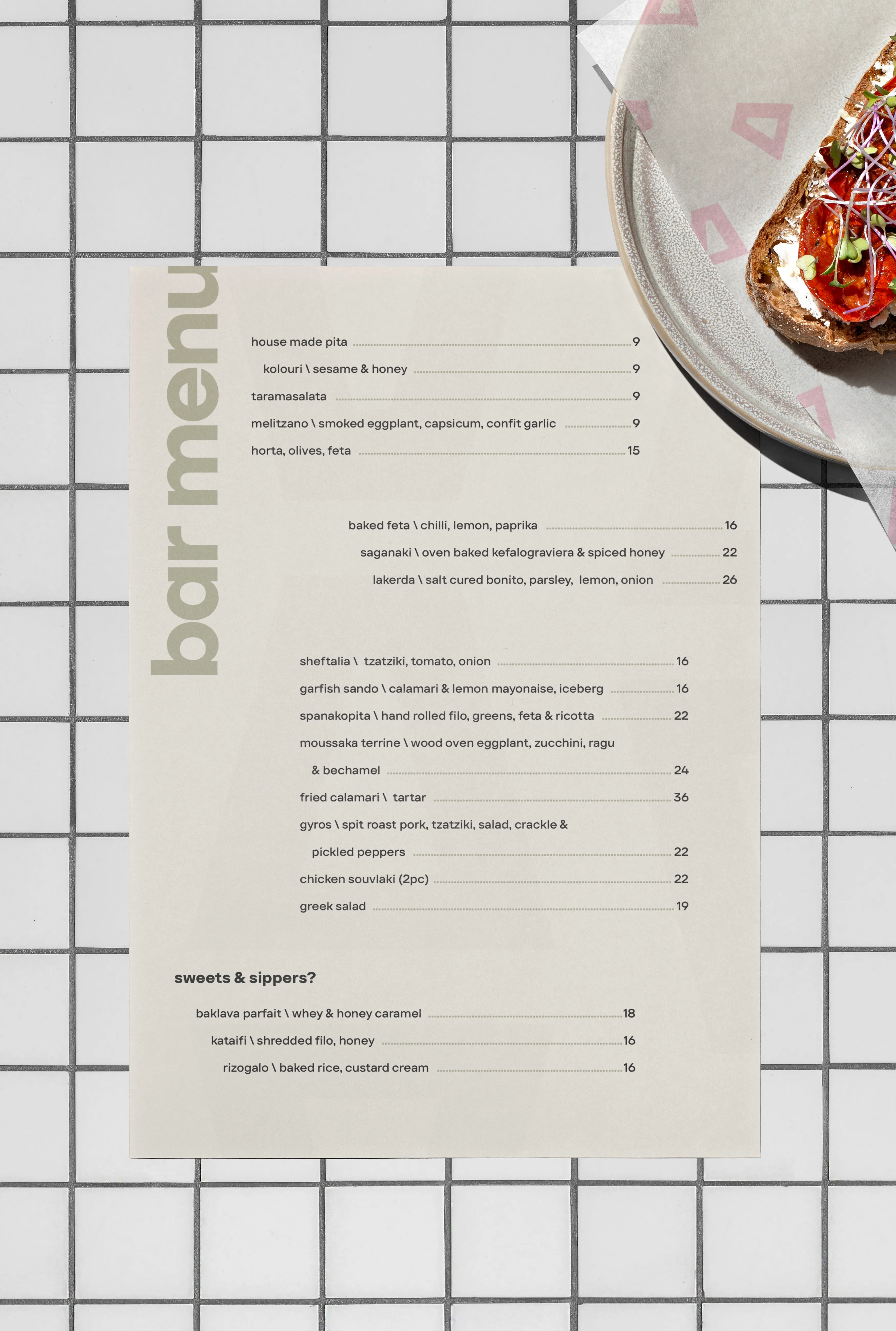
- Menu system: food (with dessert and dietaries) and drinks, heroing signature items including the Filthy Feta Martini
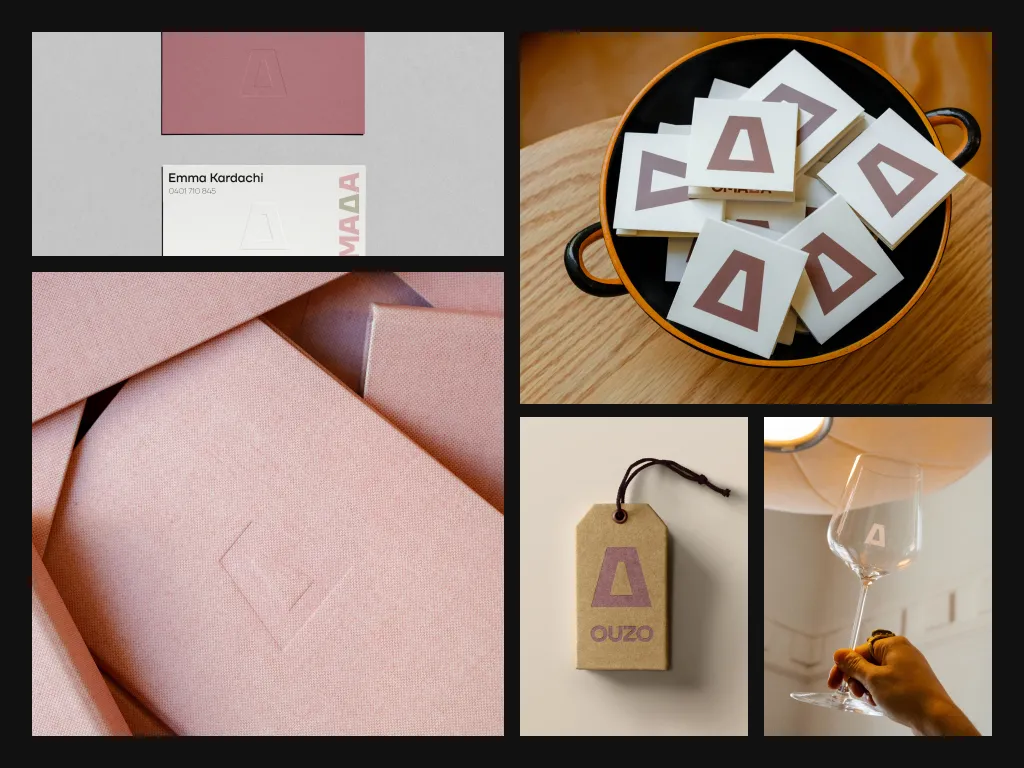
- 2,500 custom matchbooks: Delta logo front, “OMADA” on the fold, full venue details inside
- Business cards: embossed/debossed brand icon, vertical-format contact details
- Ouzo labels: etched glass logos with high-GSM kraft paper swing tags and nickel eyelets for house-made spirits. The initial direction (stickers) was replaced by a “luxe” requirement. Sourced through Kwik Kopy to get the finish right on a small detail that the target demographic notices.
Spatial branding:
- Exterior and interior signage system
- Hand-painted Dionysus motifs integrated directly into venue walls
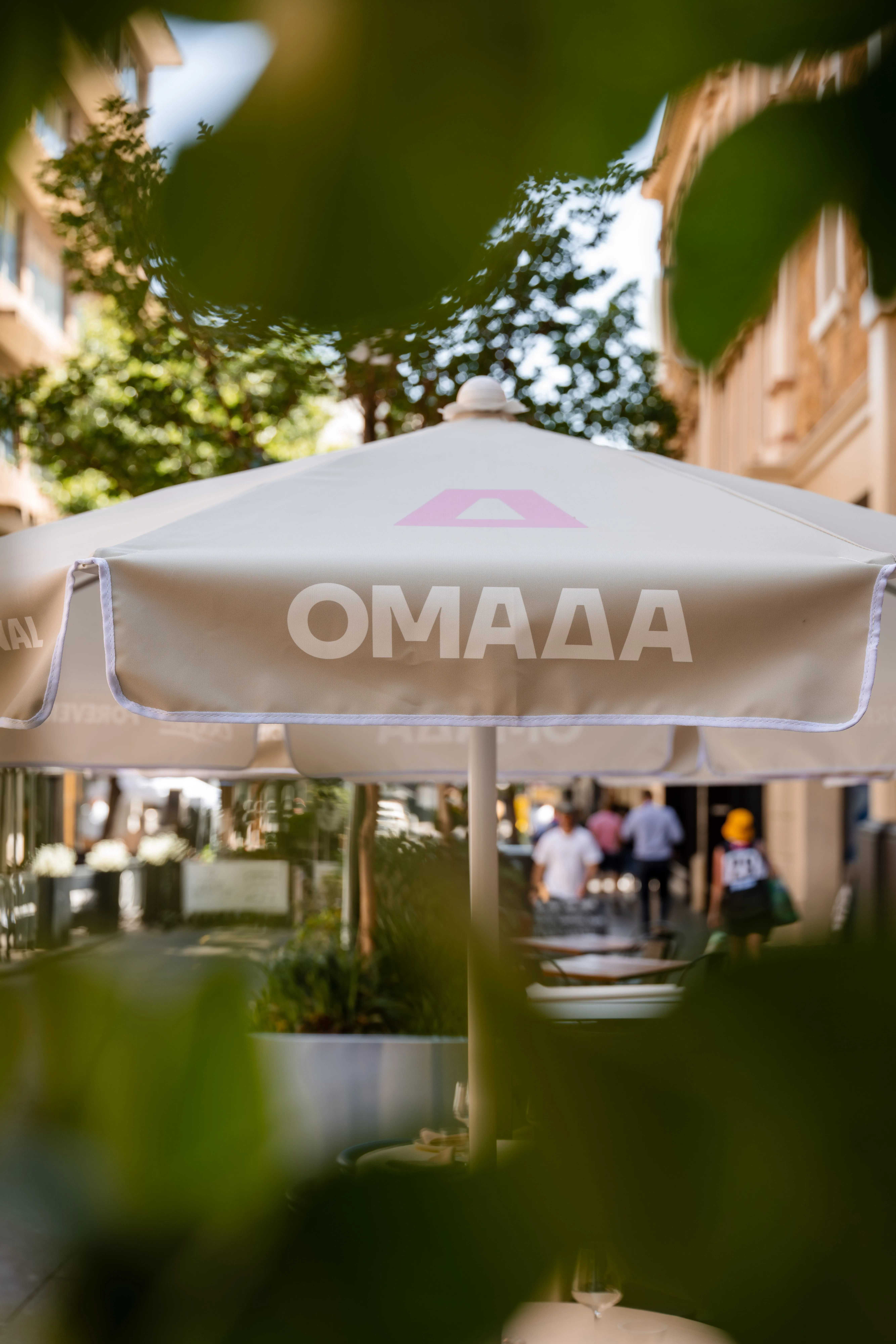
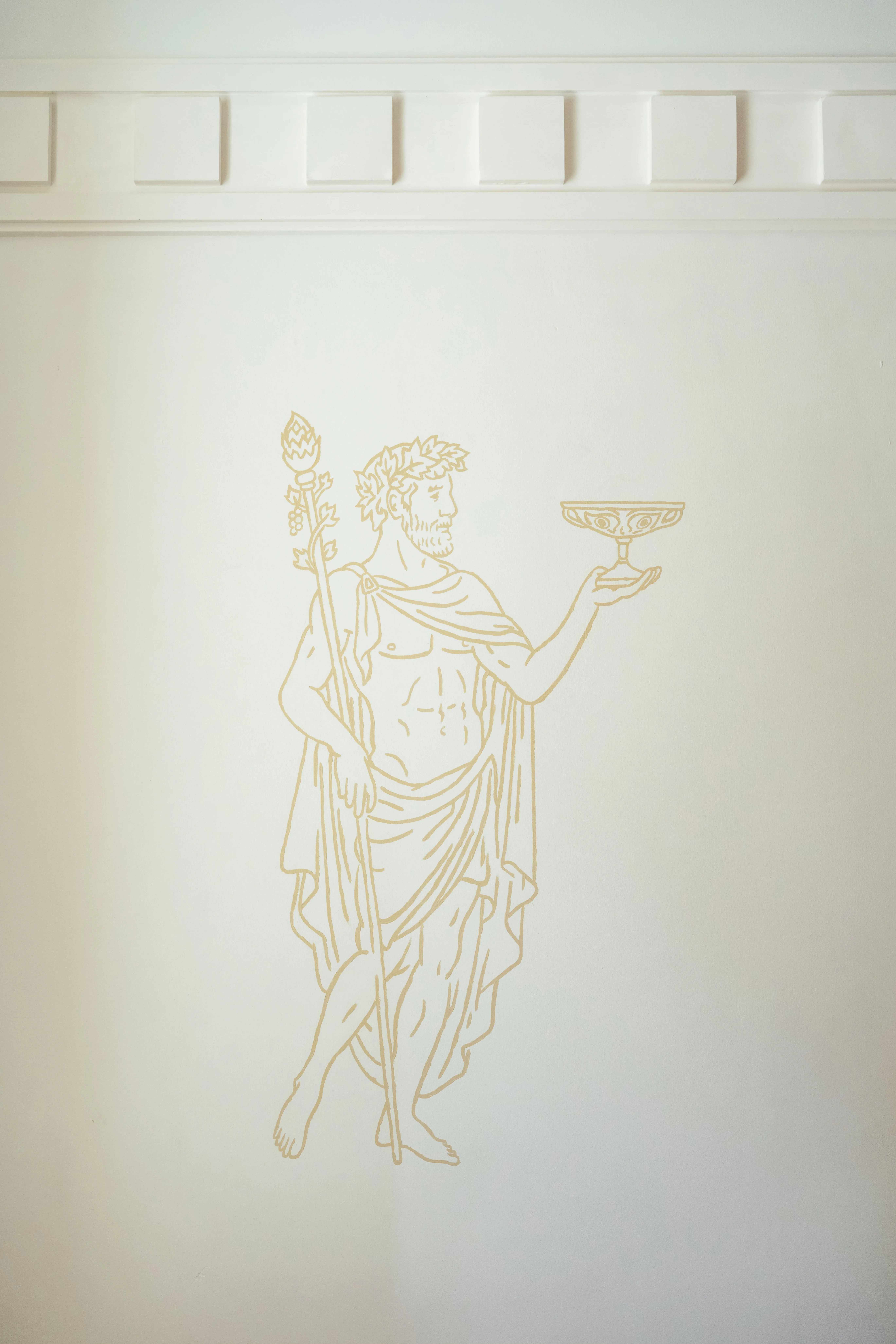
Brand guidelines: A document covering colour application, typography rules, and photography direction — a working reference the team could use after handover, not a static PDF.
Outcome
“The house-made ouzo and Filthy Feta Martini are standouts… the open kitchen puts on a show… the artful moussaka terrine has become a recurring highlight.” — Gourmet Traveller
The brand did what it was built to do. Gourmet Traveller’s coverage connected the food and the experience in the same breath: the moussaka terrine, the Filthy Feta Martini, the open kitchen, the space. That’s the outcome a brand system is supposed to produce: the critic reviewing the venue reaches for the same language as the brand itself.
The Dionysus illustration landed. Critics and diners responded to the rawer version as authentic rather than decorative. The tension between monolithic weight and warm approachability held: the venue reads as sophisticated without reading as cold.
The brand system held across every touchpoint it was designed for: frosted glassware, hand-painted walls, kraft paper swing tags, menus, matchbooks, and signage.
“Cameron delivered the brand asset suite for our hospitality venue Omada Bar & Grill. It was a short lead time but he handled the brief with efficiency, as well as all the additional work we threw his way. Cameron researched and presented three creative directions (all of which we could have run with). Cam’s creative process allowed us to bring our stakeholders along the journey and as a result, the brand development was fast and required very little refinement. He not only delivered the brief but also brought to the project some unique creative ideas that elevated the brand and venue. Cam also developed our website, social media look and feel, physical menu layouts, business cards, uniform badges, venue signage and artwork, and packaging. The result was a seamless integration of the brand from the online to the real world across all brand touchpoints.” — Emma Kardachi, Food and Wine Collective
Why They Needed Me
The Food and Wine Collective needed more than a designer who could execute a brief. They needed someone who could build an entire brand from nothing, under real deadline pressure, across every medium at once.
- Strategy before aesthetics. Without upfront market research, design decisions are guesswork. The research established what the audience expects, what the competitors are doing, and where the opportunity sits. Every subsequent design decision came from that foundation.
- Field research that changed the work. Spending time in Athens produced a different palette, a different sense of material, and a different relationship to the culture than any reference board would have. That’s not a nice-to-have. It’s why the system feels authoritative rather than assembled.
- Building conviction, not just options. Presenting three strong directions got the client to a fast decision. But within the chosen direction, there was still work to do: convincing the client the Delta symbol could carry the permanence the brand required, rather than substituting an easier mark. That meant making the case, not just delivering what was asked for. The Delta held, and so did the brief.
- Building excitement without assets. A restaurant that isn’t open yet has no photography, no atmosphere, no food. The digital presence had to generate genuine anticipation through design alone. That requires judgment about restraint, not just execution skill.
- Breadth that keeps the project coherent. Market research, strategic positioning, photographic field work, logo design, illustration direction, print production coordination, website development, mural painting on venue walls. One person, one system, no handoff points. Every touchpoint held because there was no handoff chain to introduce inconsistency.
- A single point of contact who could move. The project had many stakeholders: owners, partners, head chef, head of bar, front of house. Emma ran point, which meant decisions got made rather than debated. I supported that by being the person who could respond fast, adapt without stalling, and keep the project moving regardless of what shifted internally.
It starts with a morning.
Every project on this page began with someone deciding what to do. Three hours, $600, you leave with the decision made and a date on it. Then I build it.
Decide it in a morning · $600 →- Brand System $3500 A complete visual identity, built to last.
- Graphic Design Menu $150 The design work that comes after the brand's already built.