Russell Roberts Music
A legacy archive for a deceased musician. The emotional and strategic intelligence was irreplaceable. The mechanical coding wasn't. The first project I built using Claude Code as a junior coding partner.
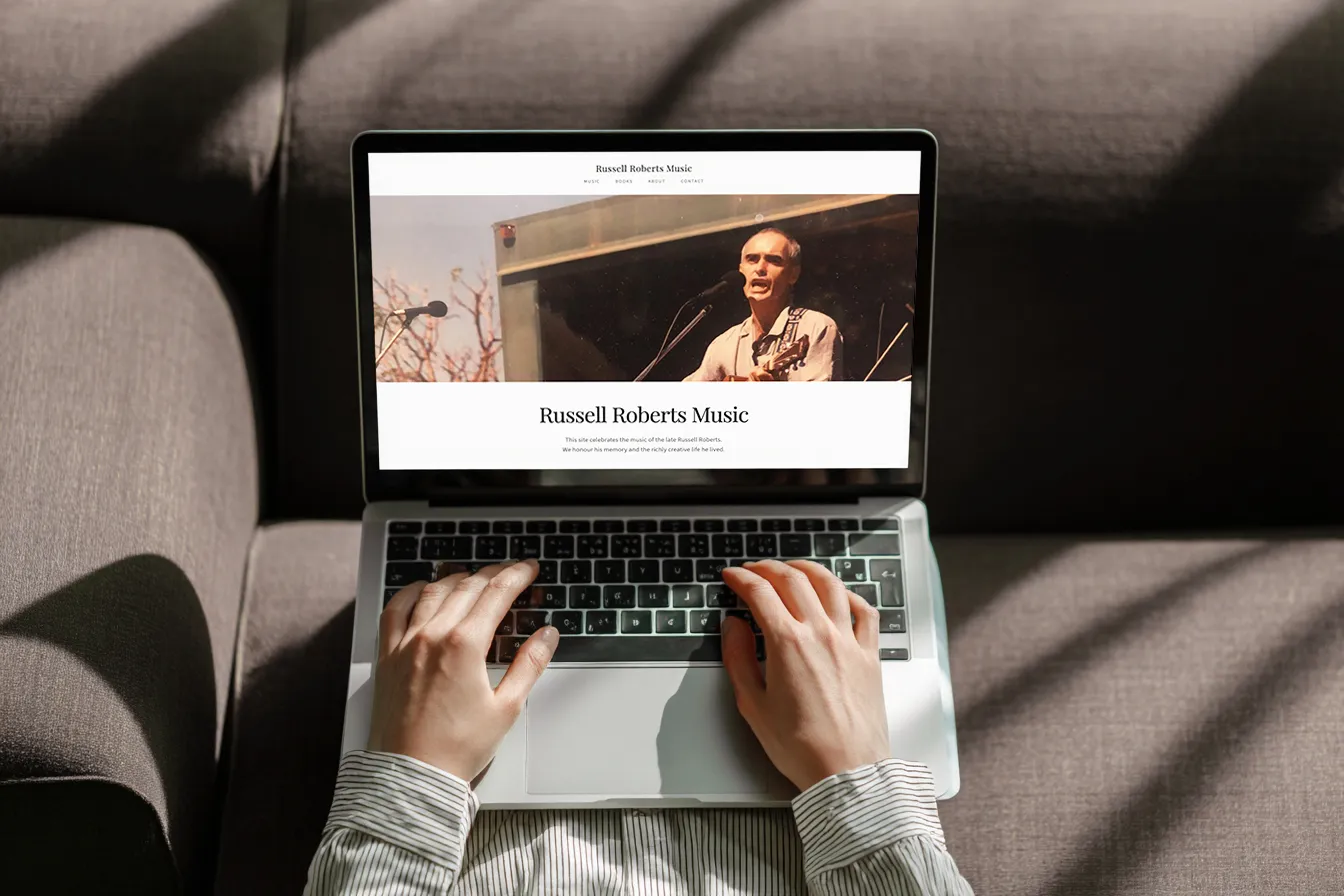
Russell Roberts Music
At a Glance
- Client: Kathryn Santospirito, managing the musical legacy of Russell Roberts
- Project: Website audit, rebuild, and full music catalogue migration
- Timeline: Feb 2026 (paid audit) to Apr 16, 2026 (launch)
- Scope: Paid discovery audit, strategy workshop, Astro design and development, content migration (9 albums), hosting setup, music distribution support
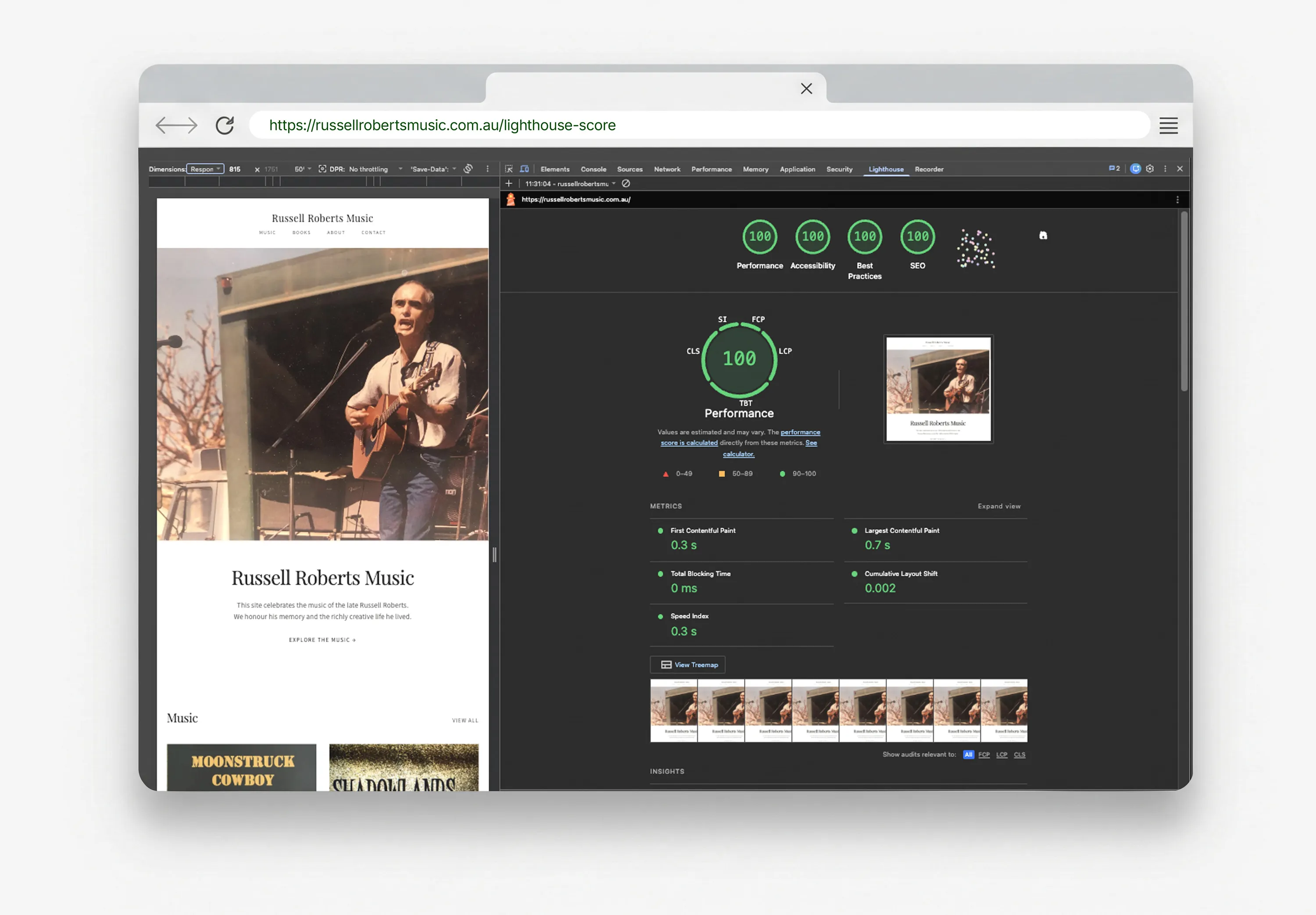
- Key result: 100/100 Lighthouse scores across all categories; stable, zero-maintenance legacy archive live at russellrobertsmusic.com.au; first project delivered with Claude Code as junior coding partner
Problem
Russell Roberts was a South Australian musician who passed away leaving behind nine albums, a single, and three posthumous releases due in 2026. His partner, Kathryn Santospirito, wanted to build something worthy of that body of work: a stable, lasting archive that preserved Russell’s music and story for family, collaborators, and the listeners who cared about his legacy.
The existing WordPress site was working against that goal. Russell had set it up himself, and when he passed, Kathryn inherited a website she had no visibility into: no documentation, no clear ownership, no understanding of what was running under the hood. The site carried years of incremental additions with no simplification: overlapping plugins, a contact form that had silently stopped sending submissions, and active security vulnerabilities that couldn’t be patched without risk of breaking other features.
The more important finding came from the data. The site had been set up to sell music through a built-in storefront. When I looked at the transaction history, there had been one sale in six years. Meanwhile, Russell’s music was already distributed through GYRO and available on the platforms people actually use. There was no sales motion to protect. Nobody was going to trust putting $30 through an insecure, outdated storefront, and maintaining one for zero commercial return was adding risk without adding value.
What the project actually needed wasn’t just a developer. It was someone with the emotional intelligence to sit with Kathryn through a genuinely difficult process, understand what mattered about Russell’s work, and make technical decisions that served the archive she was trying to build.
Scope and constraints:
- Budget: $250 for the paid audit upfront, approximately $2,000 for the strategy workshop and full build
- Timeline: no hard deadline, but emotional urgency was real as Russell’s posthumous releases were approaching
- Kathryn is not technical: all decisions had to land clearly without jargon, and the review process had to surface things she wouldn’t know to look for
- The project needed to be lean to build and maintenance-free to run, with no ongoing developer dependency
Approach
1. Ran a paid audit before touching the brief
Before any conversation about design or platform, I ran a paid discovery audit on the existing WordPress site. The $250 covered a thorough technical review: plugin conflicts, security exposures, performance issues, and the full storefront transaction history. Getting paid for that thinking matters. “Can you update my website?” is never a simple question. Untangling the complexity of an existing site takes real time, and what I find informs what I can deliver and for what price.
The audit changed the engagement. The question stopped being “how do we improve the site?” and became “what’s the right foundation to build on?” That clarity was worth the upfront cost.
2. Strategy workshop: chose the Archive, killed the shop
The strategy workshop translated the audit findings into a direction. I presented two paths: a lean Artist Hub centred on Russell’s music and story, or a fuller storefront built around sales.
The transaction data made the decision easy. One sale in six years. The eCommerce infrastructure was generating risk without generating revenue. We chose the Archive, with three pillars: a warm, minimal design led by Russell’s music; a relational catalogue where each album gets its own page; and legacy storytelling through personal notes. Kathryn had a wealth of material about each record: the context behind the songs, the people involved, the moments they captured. I called it the Paul Kelly A-Z approach once she described it, where the notes tell the story behind each record rather than just listing credits.
Removing the shop simplified everything: the architecture, the hosting, the maintenance burden, and the security exposure. The music was already on GYRO. That is better distribution than a storefront nobody trusted.
3. Wireframed in the room, skipped Figma
I had visual consensus coming out of the strategy workshop. I showed reference examples, built a lo-fi wireframe during the session, and got immediate approval on the direction: warm, minimal, the music as the centrepiece, nothing cluttered. I took my design ego out of it. This wasn’t a project that needed Figma iterations and round-trip approvals. It needed something Kathryn could trust and that would last.
I moved directly to a working Astro build rather than spending time in a design environment for a site whose visual direction was already clear.
4. Used Claude Code as a junior coding partner
This is the first project I built using Claude Code as a junior coding partner, and it shaped how the budget was possible.
To be precise about what that means: I provided all the intelligence. The strategy, the technical direction, the content architecture, the decision to use Astro, the schema design, the review of every output. Claude Code handled the mechanical execution: writing component code, formatting data structures, implementing the schema. I directed it the way I would direct a junior developer, with a clear brief, specific instructions, and careful review of the output.
Kathryn only ever dealt with me. The emotional labour, the judgment calls, the communication with a client navigating something genuinely difficult: all of that required a person. What Claude Code did was compress the mechanical coding work so that quality delivery was achievable on a $2,000 budget.
This is the model I am building toward. Human intelligence does the work that requires it. AI handles what it doesn’t.
5. Designed a schema for nine albums of relational data
The content structure was the hardest technical problem. Nine albums across 25 years meant tracks, contributors, descriptions, credits, and embedded media, all with different levels of completeness. Some albums had detailed song notes; others had only basic metadata. Some credits were complex, with multi-contributor structures that needed precise attribution across albums.
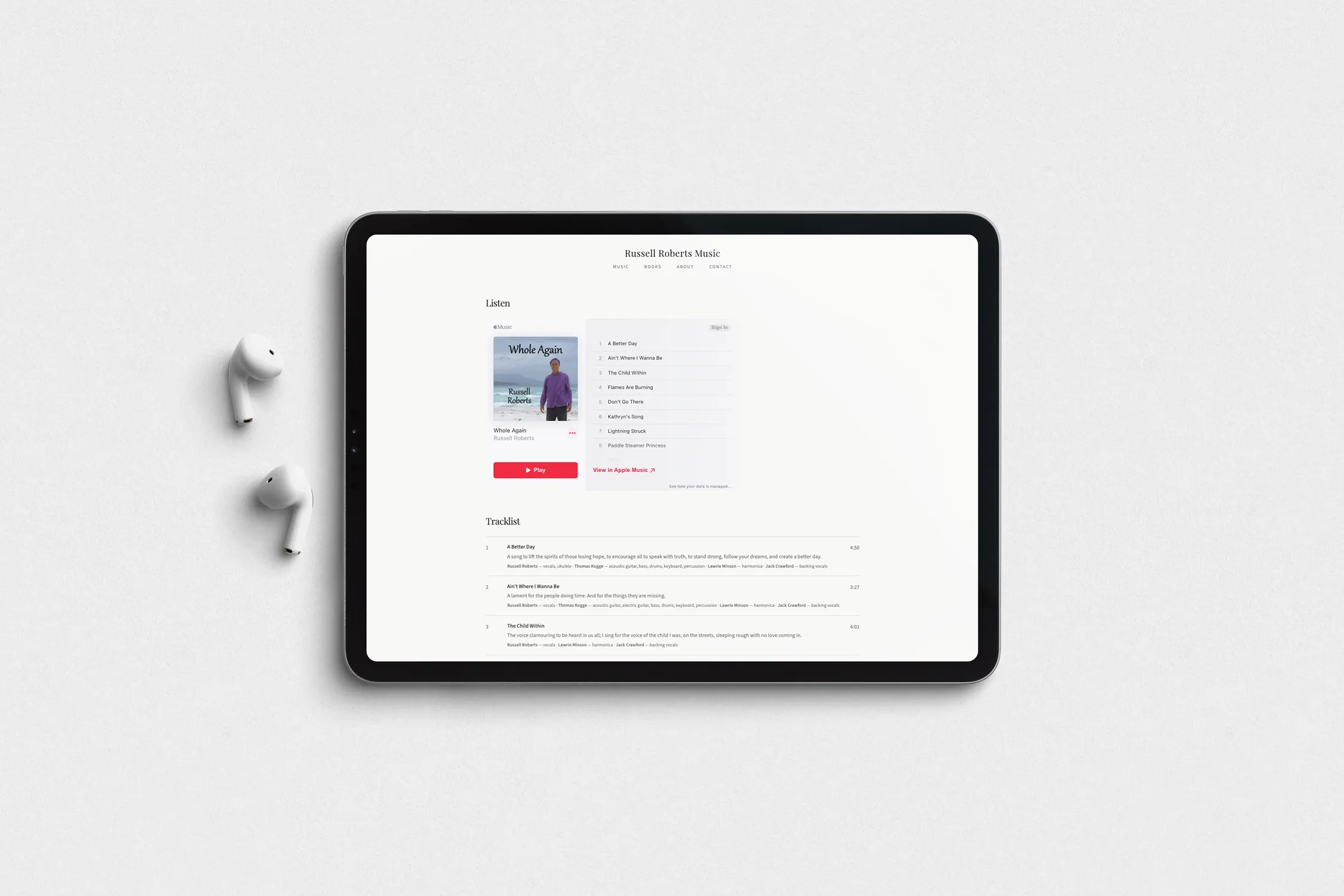
I designed an Astro Content Collections schema that could handle the relational complexity without becoming a maintenance burden. Albums, tracks, and contributors were modelled as linked collections. This meant corrections and additions during the build didn’t require touching template logic, which mattered given that three posthumous albums are still coming and credits were being corrected throughout.
6. Collaborative content pass and launch
Kathryn handled the writing: personal album notes, song descriptions, and a short bio. I handled the technical pull: formatting nine albums into Markdown, embedding Apple Music players and YouTube video links, cross-referencing and correcting credits throughout.
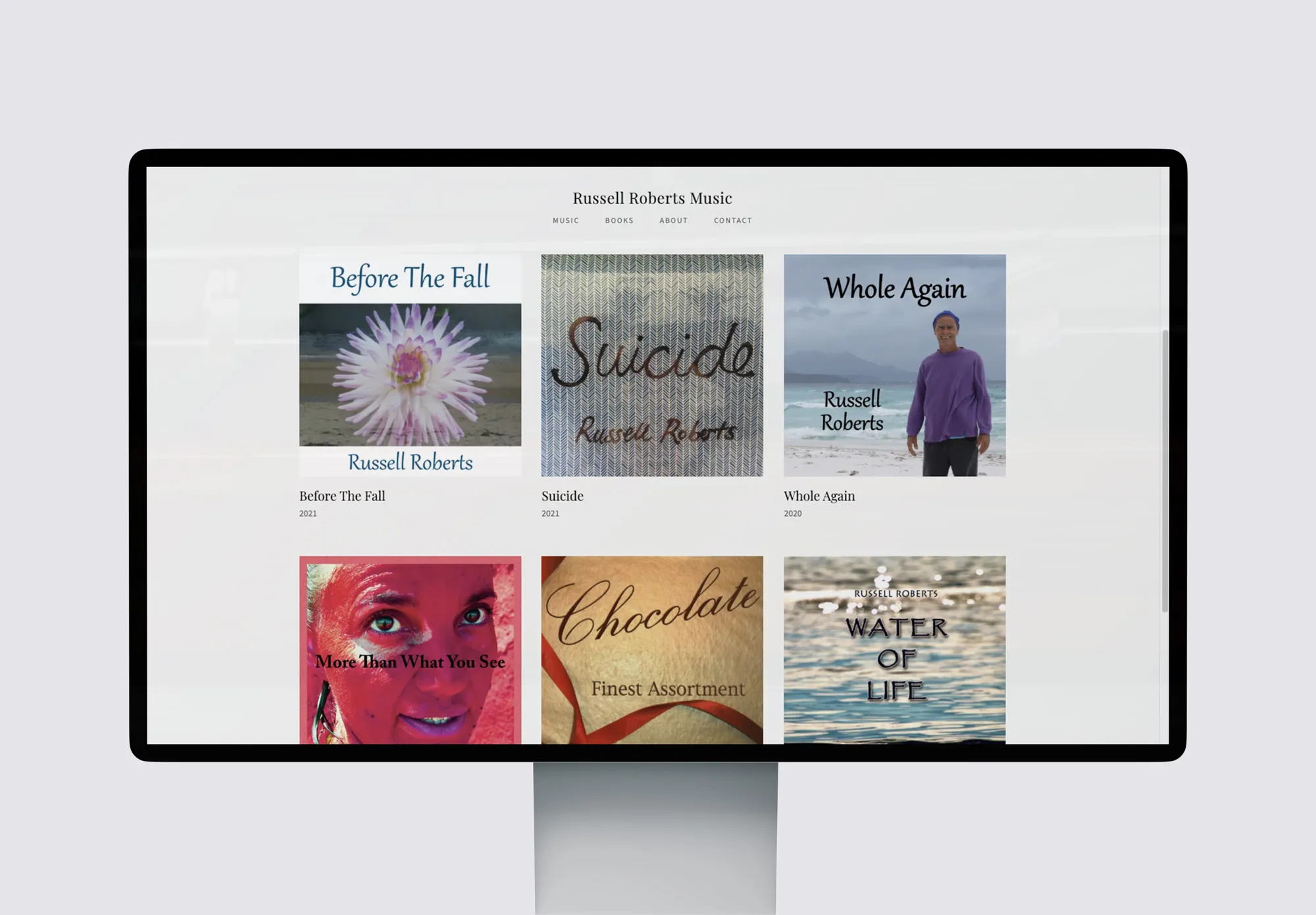
We ran two review sessions: the first to go through the initial staging site together, and a second after Kathryn had gathered feedback from Russell’s family. Remaining corrections were handled over email. The contact form was configured and tested. Domain and DNS records were migrated, site ownership verified via Google Search Console, and the site went live on 16 April 2026.
Outcome
The site launched with 100/100 Lighthouse scores across Performance, Accessibility, Best Practices, and SEO. For a client whose previous site had a broken contact form, active security vulnerabilities, and an unresponsive developer, the headline result is reliability: nothing breaks, nothing requires a plugin update, nothing can be silently compromised.
Ongoing hosting is $25/month, set up and running via direct debit from day one. The three posthumous albums have a clear path to GYRO distribution when they are ready. The archive is built to last without ongoing developer involvement.
The project also validated a delivery model. A quality static archive, 100/100 across all Lighthouse categories, with a proper relational content schema, delivered on a $2,000 build budget. That is not achievable through conventional development hours alone. It is achievable when human intelligence directs the right tool.
“I am highly satisfied with every step involved in working together with Cameron to create the new website. His clear communication, efficient way of working and his attuned nature made it a smooth, enjoyable and successful process.”
Kathryn Santospirito
Why They Needed Me
- This project needed emotional intelligence first. Kathryn was building a memorial to her partner’s life work. The technical decisions mattered, but the ability to hold space for that, to move carefully, to communicate without jargon, and to treat Russell’s catalogue with the care it deserved: that is not a development skill. It is a human one.
- The paid audit changed what the project was. Without it, the brief would have been “update the site” and the rebuild would have happened on a fragile foundation. Getting paid for discovery work is how I protect clients from spending money on the wrong solution.
- Killing the shop required someone who could read the data and make the call. One sale in six years. The music already on GYRO. Nobody trusts a dodgy storefront with $30. The right call was obvious once the data was visible, but it still needed someone willing to say it directly rather than build what the client assumed they needed.
- Static architecture required a deliberate decision against the default. Most developers would have rebuilt this on WordPress or Squarespace. Choosing Astro for a legacy archive was based on the client’s long-term maintenance reality: a site that runs without plugins, updates, or developer check-ins, indefinitely.
- The schema design kept the catalogue maintainable. Nine albums of relational data with corrections in flight and more releases coming could have become a mess. Designing the content schema upfront meant future additions require no template changes and no developer.
- Directing Claude Code required knowing what to ask for. This wasn’t vibe coding. I brought the strategy, the visual direction, the technical architecture, and the judgment. Claude Code compressed the mechanical execution. The quality came from the intelligence directing it, not from the tool itself.
It starts with a morning.
Every project on this page began with someone deciding what to do. Three hours, $600, you leave with the decision made and a date on it. Then I build it.
Decide it in a morning · $600 →- Custom Website $5500 Designed and built for your business specifically.
- Website Audit $400 Find out what's wrong before you spend money fixing it.